Social Animation Versus Static Creative Compared
 by
by 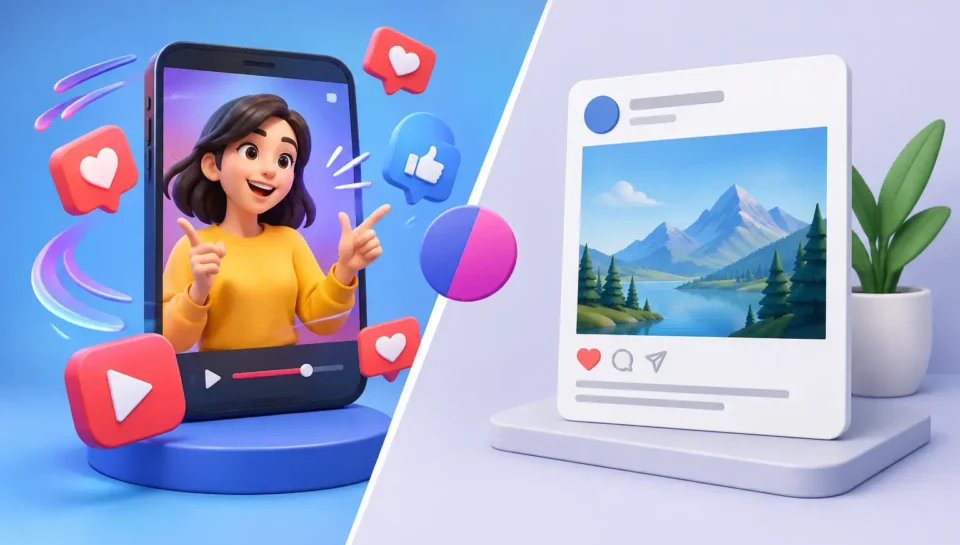
A polished social post can disappear in less time than it takes to scroll past a cup of coffee. That is the commercial reality behind social animation versus static creative. Your audience is not judging whether your design team worked hard. They are deciding, almost instantly, whether your message deserves a second of their attention.
For small businesses, that makes the choice feel urgent. Do you invest in animated content that stops the scroll, or create strong static graphics that are quicker to produce and easier to repeat? The answer is not that every post needs movement. The answer is to use the format that gives each campaign the best chance of being seen, understood and acted on.
Why motion earns attention on social media
Animation gives your message a natural advantage in a busy feed. Movement creates a visual interruption. A headline appears, a product rotates, a problem is shown and solved, or a simple icon sequence explains a service before the viewer has time to lose interest.
That matters when you are selling something people do not actively search for every day. A local accountant, training provider, care company or trade business may offer an excellent service, but a single flat image often has to work much harder to make someone stop. Motion can show the benefit quickly: less paperwork, safer staff, a cleaner property, a better event, a clearer process.
It is not movement for movement’s sake. Good social animation directs the eye towards one idea and one action. It can reveal an offer in stages, demonstrate how something works, add energy to a testimonial or make a limited-time promotion feel immediate. When the creative is built around a clear commercial message, it does more than look impressive. It makes the message easier to absorb.
Animation is especially effective when your message needs explaining
Static creative works brilliantly for a simple statement. “20% off this week” is clear. “Book your appointment now” is clear. But many businesses need to communicate a little more before a customer is ready to respond.
If you are introducing a new service, explaining a training programme, showing the steps behind a booking process or promoting an event, animation has room to build understanding without sending viewers to a page full of text. A 10 to 20 second motion graphic can take a potential customer from problem to solution to call to action with far less effort than a dense caption ever will.
This is also where animation can justify its production cost. One well-planned piece can be edited into shorter cuts, adapted for stories, used on a website, played on a screen at an event and included in a sales presentation. You are not simply buying one social post. You are creating a useful marketing asset with several places to work.
Where static creative still wins
Static does not mean second best. A clear, well-designed image can be fast, confident and highly effective, particularly when your audience already knows what you offer.
For regular updates, announcements, customer quotes, opening hours, simple offers and branded reminders, static creative is often the sensible choice. It is quicker to approve, easier to produce in volume and gives your social channels a consistent presence between larger campaign pushes.
A good static post also gives the viewer control. They can pause over a price list, read an event date or save a useful tip without waiting for frames to appear. On platforms where people scan quickly for practical information, that can be an advantage rather than a limitation.
The problem is rarely that a business uses static posts. The problem is relying on the same flat template for every message, every week, while competitors use stronger ideas, clearer offers and fresh movement to take attention first.
Static creative works best for immediate, single-message campaigns
Think of static creative as the sharp poster in your campaign. It should make one point clearly, using strong branding, a readable headline and an obvious next step. If the viewer has to decipher five messages, tiny text and three different calls to action, the format is not the issue. The planning is.
Static posts are particularly valuable for retargeting and follow-up. Once somebody has watched your promotional animation or visited your website, a straightforward image reinforcing the offer can help move them closer to an enquiry. You do not always need to tell the whole story again.
Social animation versus static creative: the real comparison
The strongest choice depends on the job the content needs to do. Animation usually wins when the goal is awareness, explanation or emotional impact. Static creative can win when the goal is clarity, frequency or a quick response to a simple offer.
Here is the bigger point: reach, engagement and conversion are not the same thing. A lively animation may generate more views and comments, but a static graphic with a direct price, deadline and booking prompt could bring more enquiries from people who are already interested. Measuring only likes will lead you towards the wrong creative decisions.
Ask what the campaign is meant to achieve. Are you trying to get noticed by new people? Do you need to explain a service that is difficult to understand in one image? Are you launching something with a deadline? Or are you reminding previous visitors why they should choose you?
Your answer should shape the format, the message and the budget.
Build a content mix instead of picking sides
The most effective social strategy usually combines both. Use animation as your attention-grabber and message-builder. Use static creative to support it with reminders, offers, proof and regular brand visibility.
For example, a fitness studio might run a short animated campaign showing the confidence and community behind its beginner classes. Static posts can then highlight class times, introductory prices, member feedback and a direct booking prompt. The animation creates interest; the still posts make acting easy.
A business-to-business service could use a motion graphic to show the cost of an inefficient process and introduce its solution. It could then follow with static posts featuring a practical tip, a client result and a straightforward consultation offer. Each format has a role, and neither is being asked to do everything.
This approach also protects your budget. You do not need to commission a full animation for every minor update. Put production spend behind your most important campaigns, evergreen explanations and high-value services. Then create a bank of static assets that keep the message active, recognisable and commercially focused.
What makes animation perform rather than simply look good
There is plenty of animated content online that achieves very little. It moves, but it does not communicate. It may use every effect available, yet never says why somebody should care.
Effective animation starts with the offer, not the software. The first seconds should establish the problem, benefit or outcome. The visuals should support a message that can be understood even with sound off. Captions matter, branding should be present without taking over, and the final frame needs a practical call to action.
Keep the idea focused. One video should promote one offer, answer one objection or explain one service. Trying to squeeze your entire business into 15 seconds creates noise, not interest.
This is where working with a creative partner who understands marketing changes the outcome. Visibility Consulting UK creates animated social content with the campaign objective in mind, helping businesses decide what deserves motion, where it should appear and how it can keep working beyond its first post.
Make the decision based on value, not fashion
Do not choose animation because it is fashionable, and do not choose static because it feels cheaper. Choose the format that makes the next customer action more likely.
If your current social feed is being ignored, motion can give your brand the interruption it needs. If you already have attention but struggle to turn it into enquiries, sharper static offers and clearer calls to action may be the missing piece. Often, the best move is a campaign where animated content earns the first look and static creative keeps your business front of mind until the customer is ready.
Your competitors are posting every day. Make sure your next post gives people a reason to stop, understand and get in touch.