Motion Graphics Versus Live Action: Which Wins?
 by
by 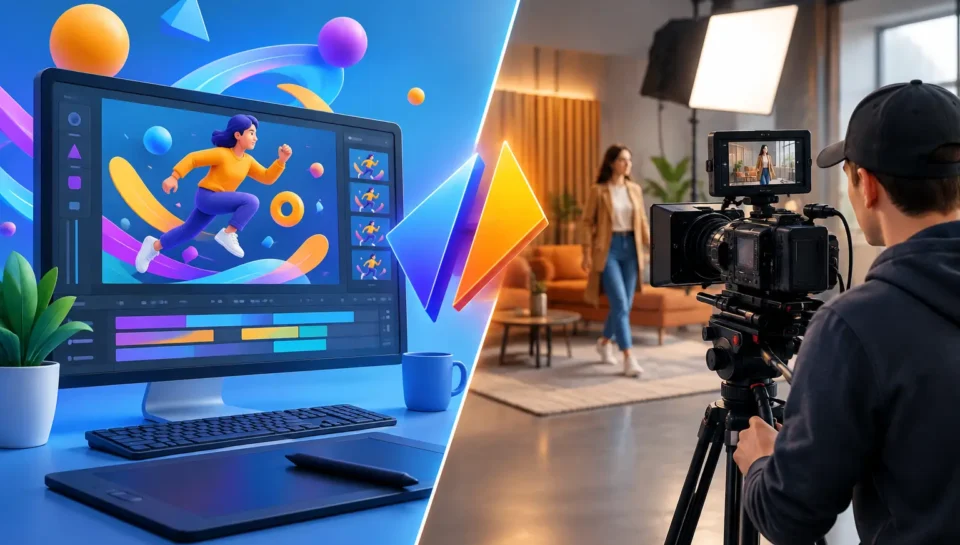
A polished live-action shoot can make your business look established. A sharp animated video can explain a difficult offer in seconds. The motion graphics versus live action decision is not about picking the format that looks most impressive on paper. It is about choosing the video that gives your audience a reason to stop, understand and act.
For a local service business, a training provider, a charity or a growing brand, every pound spent on content needs a job. Your video might need to generate enquiries, simplify a service, promote an event, build confidence in your team or keep social feeds active. The right production choice starts there.
Motion graphics versus live action: the real difference
Live action uses filmed people, places, products and events. It is the right choice when the physical reality of your business is a key part of the sale. Think of a clinic where reassurance matters, a hospitality venue with a standout atmosphere, a trades business that wants to show its team at work, or a product that customers need to see in use.
Motion graphics use animated text, illustrations, icons, charts, graphic elements and branded visuals. They can also combine with filmed footage, screen recordings or still photography. Their strength is control. You can turn an abstract process, a technical service or a sales message into something clear, punchy and visually memorable without needing to film every part of it.
Neither format automatically wins. Live action creates human connection quickly. Animation gives you precision, flexibility and a far wider creative canvas. The commercial question is simple: what does your customer need to see before they feel ready to take the next step?
When live action earns its place
People buy from people, especially where trust is the main barrier. If your business relies on personal service, a real team member speaking clearly to camera can do more than a page of polished copy. A consultant can show authority. A care provider can show warmth. A venue owner can make an unfamiliar space feel welcoming before someone visits.
Live action is also powerful for proof. Before-and-after work, demonstrations, customer testimonials, behind-the-scenes footage and event highlights give your claims a physical reality. For a restaurant, gym, salon, construction firm or retailer, the look, movement and atmosphere of the real environment may be exactly what turns interest into a booking or visit.
However, filming is not always the easy option people imagine. It involves locations, lighting, sound, presenters, permissions, schedules and weather. A poorly lit phone video with echoing audio can damage confidence rather than build it. Good live action needs planning, even when the finished video is short.
It can also become dated. New uniforms, old signage, a changed product range or a team member who has moved on can make a once-useful video feel tired. That does not mean avoid filming. It means make sure the message is worth the production effort and likely to remain relevant.
Choose live action when your audience needs reassurance
Use live action when the person, place or physical product is the proof. If someone needs to see your practitioner, meet your team, understand the scale of your operation or experience the atmosphere you provide, real footage can remove hesitation fast.
A one-minute brand film is not always required. Often, a set of short, focused clips works harder: a founder introduction, a customer story, a service demonstration and a quick social advert. The footage can then support your website, social channels, presentations and paid campaigns.
Why motion graphics work so hard for growing businesses
Most small businesses do not struggle because their service lacks value. They struggle because they explain it in a way that is too long, too vague or too easy to scroll past. Motion graphics solve that problem by making the key message impossible to miss.
An animated explainer can show a customer problem, introduce your solution, clarify the process and point to the next action in 30 to 60 seconds. Text appears exactly when it needs to. Benefits can be visualised. Brand colours, typography and calls to action stay consistent. There is no dependence on a presenter delivering every line perfectly.
This makes animation particularly useful for services that are difficult to film: accountancy, software, insurance, business consultancy, logistics, education, healthcare pathways and specialist training. You do not need to stage an awkward office scene to explain what happens after a customer enquires. You can show the journey clearly, with energy and focus.
Motion graphics are also built for change. Need to update a price, replace a statistic, add a new service or adjust a campaign message? Editing animation is often more straightforward than arranging another shoot. For businesses running regular promotions or seasonal campaigns, that flexibility protects your budget.
Choose motion graphics when clarity is the conversion tool
Choose animation when you are selling an idea, process, offer or outcome rather than a physical setting. It is ideal for social media adverts, explainer videos, training content, keynote visuals, recruitment campaigns and promotional posts that need to communicate fast on a small screen.
Animation is not just colourful decoration. The best work is strategically structured. It starts with the message your audience needs, not a collection of effects. If the viewer cannot say what you do and why it matters after watching, the video has missed its job.
Cost, speed and lifespan: the practical trade-offs
Budget matters, and pretending otherwise does not help business owners make better decisions. Live action usually carries more moving parts. Even a compact shoot may require a crew, equipment, travel, a location, styling, filming time and post-production. If several people need to appear, coordinating diaries can become the biggest cost of all.
Motion graphics can offer a more controlled route to professional content, particularly when no filming is needed. That does not mean animation is automatically cheap. Detailed character animation, custom illustration and complex 3D scenes take skill and time. But for a message-led campaign, a well-planned motion graphic often gives smaller businesses high-impact video without the cost of a full commercial shoot.
Speed depends on approvals as much as production. Live action can move quickly if a location, presenter and clear brief are ready. Animation can move quickly if the script is agreed early. The delay usually comes when a business tries to decide its message halfway through production. Get the offer, audience and call to action clear first, and either format becomes easier to deliver.
Lifespan should influence the choice too. A general animated explainer may work for years with minor updates. A video announcing a limited offer might only need to work for three weeks. In that case, do not overspend on a format built for a long shelf life. Match the investment to the campaign.
The strongest answer is often both
The best marketing does not force every message into one format. A filmed customer testimonial can establish credibility, while motion graphics highlight the key result and end with a direct call to action. A product demonstration can use real footage, then switch to animation to explain features that cannot be seen. A conference screen can use bold animated titles while your people and work take centre stage.
This hybrid approach gives you the human pull of live action and the clarity of animation. It also creates more usable assets from one campaign. A longer website video can become social clips, animated posts, presentation visuals and short adverts, each designed for its own placement.
At Visibility Consulting UK, the focus is not simply making content look good. It is deciding what should be said, where it should appear and which visual format gives it the best chance of producing a result. That is how video stops being a nice extra and starts becoming an asset that supports growth.
Make the decision before production starts
Before commissioning any video, answer four direct questions:
- Does the customer need to see a real person, place or product to trust us?
- Is our offer difficult to explain without visualising a process or outcome?
- Will this message change regularly over the next year?
- Where will people watch it: a website, social feed, sales presentation, event screen or training portal?
Your answers will quickly show whether live action, motion graphics or a combination is the smarter investment. Do not choose filming because it feels traditional, and do not choose animation just because it looks modern. Choose the format that makes your next customer understand why your business is worth their attention – then give them a clear reason to get in touch.