Animated Explainer Versus Live Action: Which Works?
 by
by 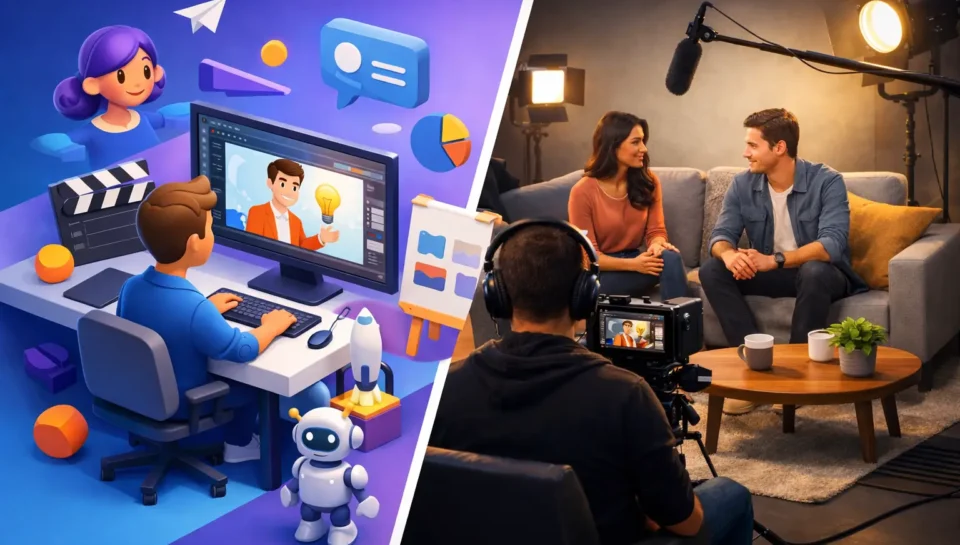
A camera crew, a studio, presenters, locations, retakes, travel, editing. Live-action video can build a powerful sense of trust, but it can also turn a simple marketing idea into a large production job. That is why the animated explainer versus live action decision matters far more than choosing a visual style. It affects your budget, speed, message clarity and, most importantly, whether people actually understand why they should choose your business.
For many small and mid-sized businesses, animation is not the cheaper substitute for video. It is the smarter route to attention. But not every message should be animated. The right choice depends on what you are selling, who needs to believe you and where the video needs to work.
Animated explainer versus live action: the real difference
Live action shows the real world. It puts your people, premises, products or customers on screen. That makes it especially effective when the proof is physical: a beauty treatment, a restaurant experience, a manufacturing process, a property, an event or a personal service where the relationship matters.
Animation does something different. It strips away the distractions and puts the audience’s attention exactly where it needs to be. It can turn an invisible process into a clear story, make data feel engaging, simplify a difficult service and give a brand a distinctive visual identity in seconds.
The question is not, “Which one looks more professional?” Both can look exceptional. The better question is, “What does my audience need to see or understand before they act?”
If they need reassurance that real people stand behind the business, live action may earn that trust faster. If they need to understand how an unfamiliar service works, animation can make the decision far easier.
When animation gives your marketing the edge
Animation is built for messages that are hard to film. Think of a financial service, software platform, healthcare pathway, training procedure or charity impact report. You could point a camera at someone talking about it. Or you could show the customer’s problem, the solution and the result through purposeful movement, branded graphics and clear visual storytelling.
That control is valuable. Every colour, icon, transition and word can be designed around one commercial goal. There is no cluttered office in the background, no weather risk, no nervous presenter and no need to explain an abstract idea with stock footage that looks like everybody else’s.
It is also highly adaptable. A well-planned animated explainer can be cut into short social posts, resized for vertical platforms, repurposed for presentations, used on a website and adapted for a trade stand or conference screen. When marketing budgets need to work harder, that flexibility matters.
Animation often delivers better value over time because changes are more manageable. Need to update a price, replace a service step, alter a call to action or refresh your branding? That is normally far simpler than arranging another filming day, bringing back contributors and recreating the same setting.
For businesses that need to look established without spending like a national brand, this is a serious advantage. Strong animation makes a smaller company look organised, confident and ready to compete.
Animation is strongest when clarity sells
Use an animated explainer when your offer needs explaining before it can be bought. That might include a new app, a subscription service, a complex booking system, a professional consultancy, internal training or a campaign that needs a clear narrative rather than a face on screen.
It is particularly effective for social media, where you have a few seconds to stop the scroll. Motion, bold typography and a sharp opening problem can earn attention quickly. A static graphic asks people to read. A good animation gives them a reason to keep watching.
When live action is worth the investment
Live action has a quality animation cannot fully replace: human presence. Seeing the founder speak, watching a therapist welcome a client or viewing a team at work can remove doubt in a way that illustrations cannot. It proves that there is a genuine business behind the advert.
This matters in people-led sectors. Healthcare providers, hospitality businesses, trades, education settings, fitness professionals and local service companies can benefit from showing the environment and the personalities customers will encounter. If your best asset is your team, put them in the frame.
Live action is also the right answer when the product itself has visual appeal. Food being prepared, machinery operating, a venue filling up before an event or a physical product being used all carry sensory detail that audiences want to see for real.
The trade-off is production complexity. A quality shoot requires planning. You need the right location, lighting, sound, contributors, permissions, wardrobe and time. Editing can solve many issues, but it cannot turn a vague idea into a convincing advert. The work starts well before the camera rolls.
That does not make live action a bad fit for a limited budget. It simply means you need a focused concept. One clear message, one setting and one strong call to action will often outperform an overambitious shoot that tries to show everything.
Budget, speed and shelf life
Cost should not be treated as a contest between “cheap” and “expensive”. The useful comparison is what the video needs to achieve and how long it will remain useful.
A live-action production can cost more because it involves people and logistics. Once a shoot day has passed, any major change may mean returning to location. Animation requires specialist creative work too, particularly for bespoke character design, detailed motion graphics or 3D visuals, but it avoids many physical production costs and makes future amendments more practical.
Speed depends on the project. A simple animated social advert can move quickly once the script and visual direction are approved. A complex animation still takes time because every scene has to be designed and animated. Likewise, a straightforward founder video can be filmed efficiently, while a multi-location live-action campaign may need weeks of coordination.
Shelf life matters just as much. If your video includes prices, seasonal offers, staff members or a dated setting, plan for change. Animation can be a better long-term asset for evergreen messages. Live action may be the stronger choice for a timely campaign where authenticity and immediacy are the priority.
The strongest answer is often both
The animated explainer versus live action debate does not always need one winner. Some of the most effective marketing combines the two.
A short live-action introduction from a founder can establish trust. Animation can then clarify the offer, highlight key benefits and end with a clean call to action. This approach works well for service businesses that need both credibility and clarity.
You can also use live-action footage as the attention-grabber and add animated titles, captions, diagrams and branded motion graphics to make it more memorable. This is especially useful for social content, where many people watch without sound and need the message to land visually.
The key is to avoid adding animation simply because it looks fashionable. Every moving element must earn its place. If it does not make the message clearer, more distinctive or easier to act on, it is decoration rather than marketing.
Choose the format around the customer decision
Before commissioning any video, start with the obstacle between your audience and the action you want them to take. Are they confused about what you do? Unsure whether they can trust you? Unaware that the problem can be solved? Or do they simply need a memorable reason to choose you now?
Animation is usually the better answer to confusion. Live action is often the better answer to trust. A blend works when both barriers are present.
Then consider where the video will appear. A homepage explainer can afford to take a little more time to build the case. A paid social advert needs impact immediately. A training video needs clarity and retention. A conference screen needs bold visuals that make sense from a distance. One format may not suit every placement, which is why planning the distribution before production saves wasted spend.
At Visibility Consulting UK, the focus is not just on making content look good. It is on choosing the visual approach that gives your message the best chance of being seen, understood and acted upon.
Your next video does not need to follow the format your competitors use. It needs to make your customer pause, get the point and take the next step. Start there, and the right creative direction becomes much clearer.


Comments
Animated Ads for Service Businesses That Sell - Visibility Consulting UK
September 9, 2026[…] Live-action video is powerful when customers need to see your team, premises or real-life work. For some businesses, that personal connection is essential. But filming can involve schedules, locations, presenters, weather, permissions and repeated editing rounds. It is not always the most practical route for a targeted campaign. […]
The Future of Social Video for Growing Brands - Visibility Consulting UK
September 13, 2026[…] Animation is particularly effective here because it makes the message move without needing a camera crew, actors, locations or a large production budget. Text can build on screen, products can be demonstrated, and complex services can become clear in seconds. For a small business, that is not a creative luxury. It is a practical way to compete with bigger brands. […]
Motion Graphics Versus Live Action: Which Wins? - Visibility Consulting UK
September 15, 2026[…] animated explainer can show a customer problem, introduce your solution, clarify the process and point to the next […]
Can Animation Explain Complex Services? Yes. - Visibility Consulting UK
October 9, 2026[…] short animated explainer is not about making a serious service look childish. It is about removing friction. Done well, it […]