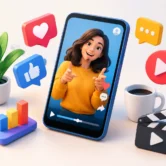
10 Best Social Media Post Formats for Business
 by
by 
A post can be perfectly branded, carefully written and still disappear without a trace. The issue is often not the offer. It is the format. Choosing the best social media post formats gives your message a better chance of stopping the scroll, explaining its value quickly and moving people towards an enquiry.
For small businesses, that matters. You do not need a huge advertising budget or a full-time content team to look credible online. You need content that is built for the way people actually browse: fast, visual and often with the sound off. The right mix of animation, video, carousels and sharp static design can make a modest campaign work much harder.
Why format matters more than posting more
Posting every day will not fix a weak content plan. If your posts all look the same, your audience learns to scroll past them. A flat image may be enough to announce a bank holiday, but it is unlikely to explain a complex service, showcase a result or build confidence before a sale.
Different formats do different commercial jobs. Short-form video is built for reach and attention. Carousels are useful when you need to educate or tell a story in stages. Customer proof builds trust. Animated graphics make an offer feel more immediate, polished and memorable.
The goal is not to chase every trend. It is to choose formats that fit your audience, message and capacity. A local clinic, training provider and trades business may all need social media content, but they should not all post the same thing.
The best social media post formats for real business growth
1. Short animated videos
If your business needs to be noticed, animated video should be high on the list. A 10 to 30-second motion graphic can introduce an offer, show a problem being solved or make a simple message impossible to miss in a busy feed.
Animation works especially well when filming is impractical, your service is hard to visualise or you want consistent branding without putting someone on camera. Think moving typography, product mock-ups, icon-led explainers, before-and-after scenes or a bold promotional advert with a clear call to action.
Keep the opening seconds strong. Start with the customer problem, a striking visual or the main outcome. Do not spend half the video revealing your logo. Branding matters, but attention comes first.
2. Reels and vertical short-form video
Vertical video is now a standard format across major social platforms. It gives businesses a chance to show personality, process and proof in a way that feels more immediate than a designed advert.
For a service business, this could be a quick look at a project, a common customer question answered on screen or a short tip from the team. For a venue, retailer or event organiser, it could show atmosphere, arrival, products or a transformation. The content does not need to be over-produced, but it must be clear, well paced and worth watching.
There is a trade-off. Casual phone footage can feel authentic, yet poor lighting, muffled audio and weak captions can make a good business look careless. Combine real footage with branded captions, motion graphics and a clear end frame to keep the human feel without sacrificing quality.
3. Carousel posts that teach or persuade
A carousel gives people a reason to pause and swipe. It is one of the strongest formats for businesses that need to explain something before a customer is ready to buy.
Use the first panel as a headline, not a poster. It should make one promise or raise one useful question. The following panels can then break down a process, tackle objections, compare options or show the steps behind a successful result. The final panel should tell people what to do next, whether that is sending a message, booking a call or saving the post.
Carousels are ideal for subjects such as “five signs your website needs attention”, “what happens after you book our service” or “how our training programme works”. They also suit case studies because they can take a viewer from challenge to solution to outcome without forcing them to read a long caption.
4. Customer testimonials and result-led posts
People trust people. A polished brand claim is useful, but a genuine customer quote, review screenshot or short client video carries a different kind of weight. It answers the silent question every prospective buyer has: did this work for someone like me?
The strongest testimonial posts are specific. “Great service” is pleasant but vague. “We received more enquiries after launching our animated advert” gives a potential customer a reason to pay attention. If possible, pair the quote with a simple visual showing the customer, the project or the result.
Always get permission before sharing customer names, logos or project details. For sensitive sectors such as healthcare and education, keep privacy at the centre of the process. Trust is the point, so do not undermine it by publishing more than you should.
5. Static graphics for fast, focused messages
Static posts are not dead. They are simply best used for messages that need to land quickly. A strong graphic can promote an event, announce a new service, share a timely offer or reinforce one memorable statistic.
The mistake is treating every static post like a crowded flyer. Too much text, too many fonts and several competing messages make people work too hard. One post should have one job. Lead with a bold headline, use a clear visual hierarchy and leave enough space for the message to breathe.
This is where consistent brand colours, type and imagery earn their keep. Your feed should feel recognisable before someone reads the business name. That consistency builds familiarity, particularly for local brands competing against louder national names.
6. Explainer posts and mini how-to videos
If customers regularly ask the same question, turn the answer into content. Explainer posts demonstrate expertise while reducing hesitation. They are particularly effective for businesses with services that feel unfamiliar, technical or difficult to compare.
A short animated explainer can show how an appointment works, what is included in a package, how to prepare for a visit or why a particular approach gets better results. A training provider can explain a course outcome. A charity can show exactly where support goes. A commercial service can clarify the difference between two options.
Make these posts customer-led, not jargon-led. Start with the confusion or concern your audience has, then answer it in plain English. Clever animation can make information easier to absorb, but the message still needs to be simple.
7. Behind-the-scenes and team content
People buy from businesses they recognise and trust. Behind-the-scenes content gives your brand a face, whether that means showing a project coming together, introducing a team member or sharing a small part of daily operations.
This format is useful when your service relies on care, craftsmanship or personal relationships. It can also make corporate communications feel less distant. A quick video of preparation before an event or a few photos from a working session can create more connection than another generic sales graphic.
Do not force it. Behind-the-scenes posts should reveal something meaningful: skill, care, quality control, progress or personality. A blurry photo of a desk does not automatically make a business relatable.
Match the format to the stage of the sale
The most effective content plans use several formats because prospects need different things at different moments. Someone discovering your business may respond to an energetic short video. Someone comparing providers may save a carousel that answers their questions. Someone close to enquiring may need a testimonial or case study to feel confident.
A sensible monthly mix might include promotional animation for reach, educational carousels for value, proof posts for trust and occasional team content for personality. Reuse the central idea across formats rather than inventing a new campaign every time. One animated explainer can become a short reel, a carousel, several static graphics and a customer-facing presentation visual.
That is how small businesses stay visible without constantly starting from scratch.
Make every format easier to act on
Attention is useful only if it leads somewhere. Each post needs a clear next step that matches its purpose. Ask viewers to book a call when the offer is ready to buy. Ask them to save a useful checklist. Invite comments when you genuinely want a conversation. For awareness content, a simple prompt to follow for more practical advice may be enough.
Keep captions readable, use subtitles on video and make visual text large enough to work on a phone screen. Many people watch without sound, and many decide in seconds whether content is relevant. Accessibility improves the experience and helps your message reach more people.
At Visibility Consulting UK, we create animated social content that gives businesses more than another post to publish. It gives them an asset designed to attract attention, explain value and support the next sale. Choose the format that suits the message, make the first seconds count, and give your audience a clear reason to respond.