Freelancer Versus Animation Agency: Which Fits?
 by
by 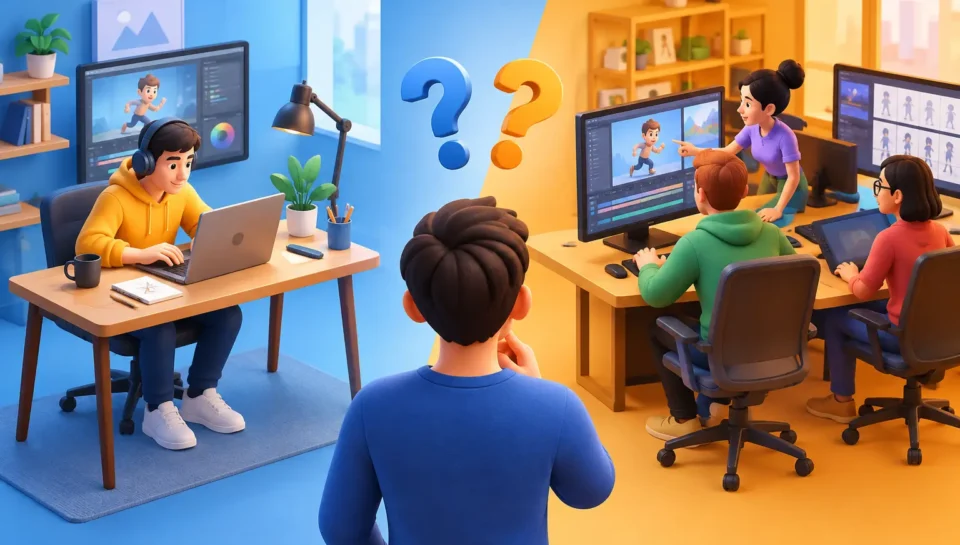
A cheap animation that does not get watched, understood or acted on is not cheap. It is wasted budget. That is why the freelancer versus animation agency decision is about far more than finding someone who can move graphics on screen. You are choosing the level of creative direction, marketing support and production certainty behind the content your audience will see.
For a one-off internal graphic, a freelancer may be exactly right. For a campaign that needs to build visibility, explain an offer and generate enquiries, an animation agency can bring considerably more to the table. The best route depends on your goals, deadlines, internal capacity and how much is riding on the finished video.
Freelancer versus animation agency: the real difference
A freelancer is usually one specialist or a small independent team. They may be highly talented at character animation, motion graphics, editing, illustration or 3D work. You often deal directly with the person doing the work, which can make communication quick and costs easier to understand.
An animation agency brings a wider production and strategic process. That can include a creative lead, script support, design, animation, sound, project management and marketing advice. You are not simply commissioning a video. You are bringing in a team to work out what should be said, how it should look, where it should be used and how it can earn its place in your marketing.
Neither option wins by default. A brilliant freelancer can produce exceptional work. A poor agency can add unnecessary layers and expense. The question is whether the supplier can solve the business problem behind the brief, not just fulfil a list of visual requests.
When a freelancer makes good business sense
Hiring a freelancer can be a smart move when the scope is clear and tightly contained. Perhaps you already have a campaign concept, approved copy, brand assets and an in-house marketing person who knows exactly how the animation will be deployed. In that case, you may simply need specialist hands to create the asset.
Freelancers can also be useful for small, repeatable tasks. Think short social posts, a simple logo sting, edits to existing footage or a set of motion graphics based on a fixed template. With less process involved, the work can move quickly.
The direct relationship is another advantage. You can speak to the animator without messages passing through several people, and the person producing the work understands feedback first-hand. For a founder-led business that likes to stay close to every detail, that can feel reassuring.
Price is often the main attraction. A freelancer has lower overheads than a full agency and may quote less for a straightforward job. But compare like for like. A lower quote might cover animation only, while you still need to organise scripting, illustrations, voiceover, music, captions, revisions and final formats yourself.
That coordination takes time. If your team is already stretched, the apparent saving can disappear quickly. Worse, a video can end up looking polished but saying the wrong thing because nobody challenged the original message.
Where freelancers can become a risk
The risk is not that freelancers lack ability. It is that one person has finite capacity, availability and range. If they are ill, booked on another project or waiting on a specialist they outsource to, your launch can slow down. For time-sensitive work around an event, product launch or recruitment push, that uncertainty matters.
You may also need to manage more of the process. A strong brief, timely approvals, consolidated feedback and clear brand files are essential. If your business has never commissioned animation before, knowing what to ask for can be difficult. Should the video open with the problem or the offer? How long should it be for LinkedIn? Will it work without sound? What call to action belongs at the end?
These questions affect performance, not just presentation. An animator may answer them well, but they are not automatically part of a freelancer’s remit. Some freelancers are excellent strategic partners. Others rightly focus on the craft they have been hired to deliver.
What an animation agency adds
An agency earns its fee when it reduces risk and increases the commercial value of the work. The strongest agencies do not begin by asking which animation style you like. They ask what needs to happen after someone watches it.
Do you need more website enquiries? Better engagement on social media? A clear explanation for a service people struggle to understand? A training video staff will actually remember? The answer changes the script, length, format, visual approach and distribution plan.
That strategic input is particularly valuable for small and mid-sized businesses. You may not have a creative director, paid media specialist and video producer in-house. An agency can bring that thinking to the project, helping you avoid spending money on content that looks impressive but has no clear job.
There is also strength in a managed process. Scripts are shaped before animation begins. Storyboards allow you to approve the direction early. Brand colours, fonts, claims and calls to action are checked before the final stage. Projects are less dependent on one individual, and a team can often handle several deliverables at once, such as a main explainer, social cut-downs, event-screen visuals and captioned versions.
At Visibility Consulting UK, that is the point of combining animation production with marketing consultancy. A business does not just need movement on a screen. It needs content that gets noticed in the right place and gives people a reason to respond.
The cost comparison is not as simple as it looks
An agency will usually cost more upfront than an individual freelancer, particularly if the project includes discovery, scripting, bespoke design and campaign planning. That higher figure can be hard to justify when you are comparing two quotes line by line.
However, the cheapest production quote is not necessarily the lowest-cost option. If you need to hire a copywriter, source a voiceover, chase feedback, redesign visuals after late-stage changes and commission extra versions for each platform, your total spend rises. So does the time taken from your team.
Look at the complete cost of getting a usable, effective asset into market. Ask what is included, how many revision rounds are available, who owns the project management, whether social formats are supplied and whether the supplier understands how the content will be advertised or shared.
A lean freelancer can be excellent value for a contained task. An agency can be better value when your brief is complex, your message needs work or the animation must support a wider marketing objective. Value comes from outcome, not from the lowest number on an estimate.
Choose based on the pressure around the project
Before deciding, assess the project honestly. You are likely to benefit from an agency if four or more of these points apply:
- Your offer is complicated and needs a clearer message before production starts.
- The video supports a launch, sales campaign, conference or high-visibility brand moment.
- You need multiple versions for websites, social platforms, presentations or training.
- Your team has limited time to brief, manage and quality-check creative suppliers.
- You want advice on where to use the animation and what it should achieve.
If none of those apply, and you have a simple, fully defined brief, a freelancer could be the more efficient choice. There is no prize for using an agency when the job does not require one.
Questions to ask before you commission anyone
Ask both freelancers and agencies to explain their process, not just show a showreel. Great-looking work is useful evidence, but it does not tell you whether they can handle your particular challenge.
Find out how they approach the script and concept, how feedback is gathered, what happens if deadlines move and what deliverables you receive at the end. Ask whether they have experience in your sector, but do not make that the only test. A supplier who understands audience behaviour and can learn your offer quickly may be more valuable than one recycling familiar industry visuals.
Be clear about success too. If you want leads, say so. If you need to reduce repetitive customer-service questions, say so. If the animation is for staff training, define what people should know or do differently after watching. A precise outcome gives the creative team something meaningful to build towards.
Make the choice that protects your marketing spend
Animation should make your business easier to notice, easier to understand and harder to forget. If a freelancer gives you the specialist skill you need with a clear brief and manageable scope, use one with confidence. If you need messaging, creative direction, dependable delivery and a plan for turning attention into action, choose an agency that can carry that weight.
Start with the result you need, then choose the production partner built to deliver it. That is how animation stops being another marketing expense and starts earning its keep.