Motion Graphics Versus Filmed Ads: Which Wins?
 by
by 
A filmed advert can put a real face, product or place in front of your audience. But motion graphics can explain a complicated service in seconds, stay on brand across every platform and avoid the cost of a full shoot. When weighing up motion graphics versus filmed ads, the best choice is not about following a trend. It is about choosing the format most likely to get your business noticed and prompt the next action.
For a local service business, charity, healthcare provider or growing UK brand, that decision has real commercial weight. You need marketing assets that look professional, work on social media and do not disappear after one expensive campaign. Here is how to make the call with your goals, budget and audience in mind.
Motion Graphics Versus Filmed Ads: The Core Difference
Filmed advertising uses live-action footage: people, premises, products, demonstrations and interviews. It gives viewers something tangible to connect with. A chef preparing a dish, a therapist welcoming a client, or a team delivering work on site can build immediate confidence because the audience can see the people and environment behind the business.
Motion graphics use animated text, icons, illustrations, charts, logos and visual effects to communicate a message. They are particularly effective when what you sell is difficult to photograph or explain quickly. Think financial services, software, training, care plans, consultancy, membership offers or a process with several steps. Animation turns abstract ideas into clear visual stories.
Neither format automatically wins. A filmed ad is not more trustworthy simply because it uses a camera, and an animated video is not automatically cheaper because there is no shoot. The real question is simpler: what does your audience need to understand or feel before they make contact, book, buy or donate?
When Filmed Ads Earn Their Budget
Live-action video is powerful when the person, place or physical result is the product. If you run a salon, restaurant, gym, construction company, venue or clinic, film can make the experience feel real before a potential customer arrives. It gives your business texture, personality and proof.
It is also useful when trust depends on seeing the team. For professional services, a short, well-shot founder message can make a business feel more approachable than a page of polished copy. For a care organisation, education provider or community project, footage of genuine people can carry emotional weight that animation may not match on its own.
A filmed advert works best when you have something worth showing and are prepared to plan properly. That means selecting the right location, getting staff comfortable on camera, considering lighting and sound, and allowing time for approvals. Good live-action content is not just someone holding a phone in the office. If the footage looks rushed, it can undermine the confidence you are trying to create.
There is another practical issue: filmed content can date quickly. Staff leave, prices change, branding evolves and premises are refurbished. If a key message changes after filming, updating it may mean arranging another shoot or accepting an advert that no longer reflects the business.
Why Motion Graphics Give Small Businesses More Firepower
Motion graphics are built for clarity, speed and repeat use. They can introduce an offer, explain a process, promote an event, highlight customer benefits or turn a presentation into something people actually remember. There is no need to coordinate a filming day, tidy the workplace or persuade reluctant staff to appear on screen.
That flexibility matters when your marketing changes regularly. An animated advert can be adapted for a new price point, seasonal campaign, exhibition, social post or website banner without rebuilding the entire project from scratch. The same core visual assets can support a 30-second promotional video, a square social post, a vertical Reel and keynote visuals for an event.
Animation also gives you control that film cannot always offer. You can show a journey through a service, visualise data, make an invisible process visible and keep every frame aligned with your brand colours, typography and tone. For businesses competing in noisy social feeds, that consistency helps recognition build over time.
Cost is often a major reason to choose motion graphics, but it should not be the only one. The value is in what the asset can do after launch. A strong animated explainer can support sales conversations, onboarding, training, social media, email campaigns and your website. Instead of paying for a single campaign clip, you create a useful marketing tool with room to evolve.
Choose the Format Based on the Job
Do not start by asking, “Should we make an animated video or film something?” Start with the problem your advert needs to solve.
If you need people to see the quality of a physical product, a transformed space or a real customer experience, filmed content is usually the stronger starting point. A beautifully animated kitchen renovation is still less persuasive than seeing the finished kitchen, the craftsmanship and the homeowner’s reaction.
If you need to explain why your service matters, how it works or what happens next, motion graphics are often the smarter choice. They remove clutter, guide attention and make a message easier to follow. This is especially useful when viewers are scrolling quickly and giving you only a few seconds to earn their interest.
For a time-sensitive campaign, animation may also get you to market faster because it avoids location logistics, weather problems and reshoots. On the other hand, if a customer testimonial is central to the campaign, filming a real person speaking about their experience can be far more compelling than animated words on screen.
The strongest marketing does not treat this as a permanent either-or decision. It uses the right format at the right point in the customer journey.
The Best Answer Is Often a Hybrid Advert
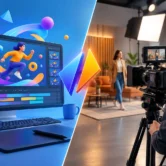
A hybrid video combines filmed footage with motion graphics. You might film your team, product or venue, then add animated captions, benefits, brand elements, calls to action and simple visual explanations. It gives you the warmth of real footage and the clarity of animation.
This approach works particularly well on social media, where many viewers watch without sound. Animated text can deliver the message even when audio is off, while filmed footage stops the content feeling generic. It is also an effective way to make modest footage work harder. A few well-planned clips can become a polished campaign when supported by purposeful motion design.
For example, a training provider could use short clips from a classroom, animated diagrams to explain the course structure and clear on-screen prompts for bookings. A trades business could show work in progress, then use motion graphics to highlight guarantees, service areas and contact details. The footage establishes proof; the animation makes the sales message impossible to miss.
Budget Is More Than the Initial Production Cost
A low-cost advert that does not explain the offer, suit the platform or give viewers a reason to act is not a bargain. Equally, a high-end filmed campaign is wasted if it is used once and then forgotten. Your budget should reflect the shelf life and number of uses you need from the content.
Filmed ads can involve costs for crew, equipment, locations, travel, talent, styling and editing. Those costs are justified when the production captures valuable material you can reuse across campaigns. Plan for a library of useful shots, not just one finished video.
Motion graphics require strategy, scripting, design and animation time. They are not a shortcut for a vague message. Before animation begins, you need to know the audience, the key benefit, the desired action and where the video will appear. A clear message keeps production focused and makes every second work harder.
At Visibility Consulting UK, the aim is not to push animation just because it looks impressive. It is to create high-impact content that fits the business objective, whether that means a fully animated promotional video or motion graphics that lift filmed material into a stronger advert.
Make the Decision Before Production Starts
Before commissioning anything, define the one action you want viewers to take. It may be booking a call, requesting a quote, visiting a shop, registering for training or donating to a cause. Then consider what stops them acting now. Do they need proof, reassurance, understanding or urgency?
Proof often calls for film. Understanding often calls for animation. Reassurance may need a combination of both. Urgency can be delivered in either format, provided the offer is clear and the call to action is visible.
Also think about where the advert will live. A video for a conference screen has different needs from a six-second social clip. Website visitors may watch a longer explainer, while social audiences need the message early, clear captions and a visual hook from the first frame. Build for the placement, not just the idea.
Your next advert does not need to look like a national television campaign to make a commercial impact. It needs a sharp message, a professional finish and a format that makes your audience stop, understand and act. Choose the footage, animation or hybrid approach that serves that goal, then put it where your customers are already looking.