Social Video Versus Static Posts for Growth
 by
by 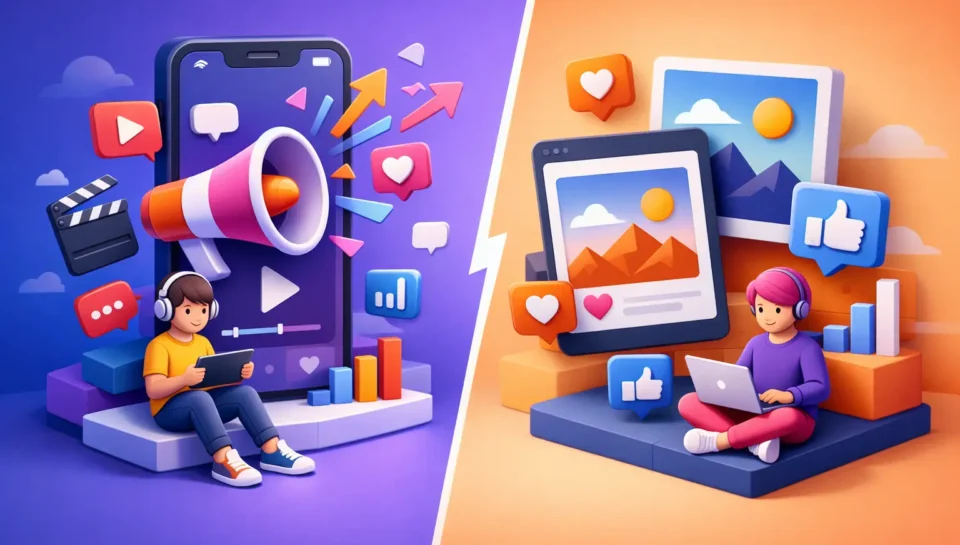
A potential customer is scrolling quickly, half-watching content between meetings, messages and real life. Your business has seconds to make them stop. That is why the question of social video versus static posts matters far more than choosing a trendy format. It affects whether your offer gets noticed, understood and acted on.
For small and mid-sized businesses, the answer is not that static posts are dead. They are not. But if your feed is relying on single images and text-heavy graphics alone, you are leaving attention, personality and sales potential on the table. Video gives your message movement, pace and emotion – three things static content has to work much harder to create.
Social Video Versus Static Posts: The Real Difference
Static posts are fixed visuals: a branded graphic, product photograph, testimonial card, event announcement or carousel slide. They are quick to absorb, useful for clear messages and often affordable to produce in volume. A good static post can announce an offer, reinforce your brand colours or put an important date in front of the right people without overcomplicating the message.
Social video adds time, movement, sound and narrative. It can show a problem, introduce a solution, demonstrate a service and finish with a call to action in under 30 seconds. Animated video is especially effective where there is nothing physical to film, where a process is hard to explain, or where you need a polished result without arranging a full shoot.
The commercial difference is simple. A static post asks someone to pause and read. A strong video gives them a reason to keep watching. That extra moment is where interest begins.
For service businesses, this is a serious advantage. If you sell expertise, care, training, advice or a process that happens behind the scenes, a photograph may not explain enough. Motion graphics can turn an abstract service into a clear, memorable story. A healthcare provider can explain a patient journey. A training company can show what learners gain. A local trades business can demonstrate the before-and-after value of its work. The message becomes easier to grasp because it is being shown, not merely stated.
Why Video Gets More Attention
Movement naturally competes for attention on busy social feeds. A subtle animated headline, a product appearing on screen or a sequence of clear visual steps gives people a reason to stop scrolling. This does not mean every video needs flashing effects, loud music and a dozen scene changes. In fact, that approach can make a brand look desperate.
The best social video is focused. It gets to the point quickly, makes one valuable promise and gives the viewer a clear next step. The opening needs to earn attention immediately. Start with the problem your customer already recognises, a bold benefit, a surprising visual or a direct question. Do not spend five seconds on an elaborate logo reveal while your audience disappears.
Video also builds familiarity faster. People can see your brand style in action: your colours, your tone, your confidence and your way of solving problems. With animation, you can make even a relatively straightforward message feel distinctive. That matters when every local competitor is posting the same stock image with a generic caption.
There is also a trust factor. A short explainer video can make a business feel more established and prepared. It shows that you have thought about the customer’s questions before they have even picked up the phone. For organisations that need to communicate clearly – education providers, charities, clinics, professional services and B2B firms – that clarity can be more persuasive than a heavily designed image.
When Static Posts Still Do the Job
Static content has a valuable place in a practical social strategy. If you need to communicate one simple fact, a clean graphic may be the stronger choice. Think of a holiday opening time, an event date, a limited offer, a customer quote or a quick reminder to book. The viewer should understand it in a glance.
Static posts are also useful for consistency. A well-designed set of branded graphics helps keep your business visible between campaign videos. They give your feed structure and make sure your message is not dependent on one major production every few months.
Carousels can work particularly well when your audience needs to compare options, follow a short checklist or see a step-by-step explanation at their own speed. They encourage interaction without requiring the viewer to watch to the end. That can be helpful for more detailed information, such as service packages, common questions or practical tips.
The trade-off is that static posts must work harder to create emotion and momentum. They need strong design, concise wording and a clear hierarchy. A cluttered graphic is not a static post strategy. It is simply a missed opportunity sitting in someone’s feed.
Use the Format That Matches the Job
The strongest marketing does not treat video and static content as rivals fighting for the same budget. It gives each format a clear role.
Use video when you need to explain, demonstrate, introduce, reassure or create a stronger emotional response. A promotional animation can launch a new service. A short motion graphic can turn a complex offer into something immediately understandable. A testimonial-style video can bring customer results to life. A training video can reduce repeated questions and make internal communication more engaging.
Use static posts when you need to reinforce, remind, announce or direct attention to one specific point. They are ideal support assets around a video campaign. One animated promotional video can produce a series of companion graphics: a launch post, a key-benefit post, a testimonial quote, an offer reminder and a final call-to-action graphic.
That approach stretches your budget further and keeps your campaign coherent. Rather than commissioning disconnected posts every week, build a core message and let it appear in different forms. Your audience may see the video first, then notice a simple graphic later, then respond when an offer reminder appears. Repetition is not boring when it is branded, useful and varied.
Make Social Video Work Harder for Your Business
Creating video is not enough. Plenty of businesses invest in a beautiful animation, post it once and wonder why enquiries do not suddenly flood in. The asset needs a job, a destination and a sensible distribution plan.
Start by deciding what the viewer should do next. Do you want them to request a quote, book a consultation, visit your website, register for an event or understand a new service? One video should normally focus on one action. If you ask viewers to follow, share, enquire, download, call and buy all at once, the message loses force.
Keep the structure tight. Lead with the issue or outcome. Show how your business solves it. Add proof where possible, whether that is a result, a client benefit, a visual demonstration or a clear point of difference. Then finish with a direct instruction. Strong calls to action are not pushy when they help an interested person know what to do.
Design for silent viewing too. Many people watch social content without sound, especially during the working day. Captions, on-screen text and clear visual storytelling are essential. Audio can add energy, but the video should still make sense with the volume off.
Format matters as well. Vertical video suits mobile-first feeds and stories. Square or portrait formats can hold more screen space than traditional landscape footage. Short versions can create awareness, while a longer cut can live on your website, in a presentation or as part of a sales follow-up. One professionally planned animation can work across several touchpoints rather than becoming a one-use expense.
Stop Measuring Likes Alone
Likes can be encouraging, but they are not the whole story. A video with fewer likes may generate more enquiries because it reached people who actually need your service. The right measures depend on your goal: watch time and completion for awareness, clicks for traffic, messages and form submissions for lead generation, or booked calls for direct sales.
Look at what happens after someone sees the content. Are people asking better questions? Are they arriving on your website with more understanding of what you offer? Is your sales team repeating fewer explanations? These are real signs that your content is doing commercial work.
At Visibility Consulting UK, the aim is not to make animation for animation’s sake. It is to create content that gives your business a sharper message, stronger visibility and a practical route towards more engagement and conversion.
The Better Choice Is Usually Both
If your business needs to stand out, video should be a central part of your social content, not an occasional extra reserved for big launches. It gives you the best chance to show value quickly, put personality into your marketing and make complex services easier to buy.
But static posts still earn their place when the message is simple and the timing matters. The smart move is to let video carry the story while static visuals keep the campaign visible, recognisable and active. Start with the message your customers most need to hear, then choose the format that makes it impossible to ignore.